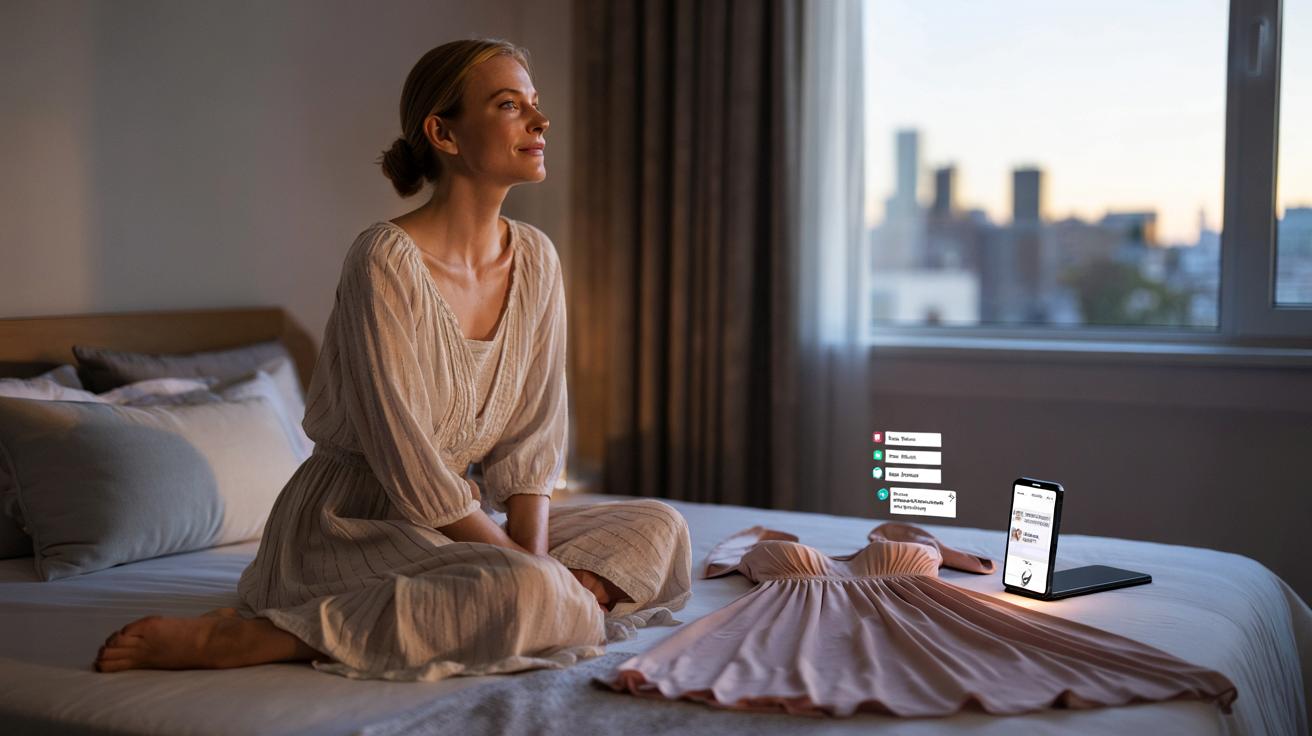
Ten minutes before her 40th birthday dinner, Ana was sitting on the edge of her bed, staring at three dresses. One was “age appropriate” and approved by her mother. One was stylish enough for Instagram, chosen by friends during a frantic group chat. The third was a loose, soft thing she secretly loved and never posted online because it wasn’t “flattering”. Her phone buzzed with messages: “Don’t be late”, “You HAVE to wear the black one”, “Tonight has to be perfect.”
She suddenly realized everyone had already decided what her happiness should look like.
She had no idea what she actually wanted.
She picked up the soft dress.
And something inside her quietly clicked.
The quiet burnout of living for everyone else
There’s a particular kind of exhaustion that doesn’t show on your face.
You can sleep eight hours, drink the green juices, hit your steps, and still feel this hollow hum in your chest.
A therapist I spoke with described it as “expectation fatigue”.
You’re not just tired. You’re tired from carrying other people’s dreams, fears, timelines, and standards on your back.
From the outside, your life might look successful. Inside, it feels like you’re renting it from someone else.
One of her clients, a 32-year-old lawyer, arrived in therapy with what she called “a perfect LinkedIn life”.
Top firm, polished apartment, partner who ticked all the boxes. Her parents proudly dropped her name at every dinner.
Yet she would sit in her car every morning, engine off, scrolling through photos of people who worked in bakeries, surf hostels, tiny bookstores.
Not because she wanted those exact jobs, but because they smelled like freedom.
Like lives that weren’t being constantly judged on a scale.
The therapist’s claim is sharp and simple: **the happiest phase of life usually begins the day you stop chasing other people’s expectations**.
Not on your birthday, not at retirement, not when you hit some mythical “I don’t care anymore” age.
It starts the first time you treat your own needs as non-negotiable.
When you stop being a walking survey of what your parents, partner, boss, and social circle approve of.
*That’s the morning, she says, when people start walking into her office looking lighter without quite knowing why.*
The small rebellions that change everything
The therapist’s method is almost disappointingly simple.
She doesn’t ask people to quit their jobs overnight or cut off their families.
➡️ Waze and Google Maps no longer show the shortest routes, angry users speak out
➡️ Astronomers think they finally know what James Webb’s mysterious “little red dots” really are
➡️ Scientists discover an object from another system racing toward us at record speed
➡️ Greenland crisis: Denmark urges officials to switch off Bluetooth to avoid spying risk
➡️ How to clean a blackened patio and garden paths with almost no effort
➡️ Gen Z is losing a 5,500‑year‑old skill: 40% are losing mastery of handwritten communication
First, she asks for one tiny act of disobedience a week.
One thing you do purely because it feels right to you, even if it makes zero sense to anyone else.
Wear the “wrong” outfit to a family event. Say no to drinks when you’re tired. Sign up for pottery instead of that “career-boosting” course.
She tells the story of a man in his late fifties, a former sales director who had spent his entire life “being impressive”.
He came to her after a mild heart scare, terrified but still talking in performance reviews.
His calendar was packed with networking, mentoring, family obligations, social dinners.
His quiet dream? To learn the piano.
Not to perform, not to post it, just to play one song cleanly in his living room.
His first “rebellion” was simply blocking one hour on Sunday mornings and calling it a “non-negotiable appointment”.
This sounds almost trivial, yet her explanation is brutally logical.
Each time you act against your own wants to please someone else, your brain files a silent message: “My needs are less valid.”
Repeat this for years and you don’t just lose preferences, you lose a sense of self.
Those tiny acts of disobedience reverse the message.
With every small “no” to expectations and every quiet “yes” to yourself, you rebuild internal trust.
That’s when people begin to feel less like actors in a script and more like authors who can edit a scene.
How to stop performing and start living (without blowing up your life)
The therapist suggests starting with one simple question, asked several times a day: “Who am I doing this for?”
Not as a deep philosophical exercise, just as a quick internal check.
About to say yes to a meeting, a favor, a weekend plan?
Pause for three seconds and run that question.
If the honest answer is mostly “So they won’t be upset” or “So I still look good in their eyes”, that’s your red flag.
She also warns that the first waves of change often look messy from the outside.
You might say no and feel guilty. You might disappoint someone whose approval you’ve chased for years.
That doesn’t mean you’re doing it wrong.
It usually means you’re crossing the invisible line between being “a good kid” and being an actual adult.
Let’s be honest: nobody really does this every single day.
You’ll slip back into people-pleasing, then catch yourself again.
The point isn’t perfection, it’s noticing when you’re abandoning yourself and gently returning.
“People think freedom will feel like fireworks,” the therapist told me. “Most of the time, it feels like a quiet exhale. You order the dish you really want. You stop explaining yourself so much. You realize the world doesn’t end when someone is mildly disappointed in you.”
- Micro-check your choices — Ask “Who is this really for?” before you agree, buy, post, or commit.
- Start “low stakes” — Practice honesty on small things like food, clothing, free time before tackling big life decisions.
- Expect emotional whiplash — Relief and guilt can coexist; that doesn’t mean your choice is wrong.
- Track real joy, not applause — Notice where you feel quietly alive, not just loudly praised.
- Protect your experiments — Treat new boundaries like seedlings; share them only with people who handle them gently.
When life finally starts to feel like yours
Many people imagine that their happiest phase will arrive when some external condition changes.
When they earn more, move cities, find “the one”, escape a toxic boss.
The therapist sees another pattern entirely.
Joy tends to appear when people stop living like a never-ending audition.
When they stop editing themselves for an invisible jury and let some edges show.
This shift doesn’t always look dramatic from the outside.
The lawyer might still be a lawyer, but now she takes long solo walks without feeling she needs a productivity podcast in her ears.
The sales director still attends family dinners, but he leaves on time to go home and practice piano.
Sometimes the external life barely changes, yet the inner experience flips.
They no longer measure their days by who approved, who praised, who noticed.
They measure them by a quieter metric: “Did I abandon myself, or did I stay with me?”
You might recognize pieces of your own story in theirs.
Maybe you feel that low hum of expectation fatigue.
Maybe you’ve started to suspect that the life you’re polishing doesn’t quite fit your soul.
The therapist’s claim isn’t a slogan, it’s a kind of invitation.
The happiest phase of life might not be a decade or a milestone.
It might be the season that starts the first time you choose your own voice over the chorus around you.
| Key point | Detail | Value for the reader |
|---|---|---|
| Spot “expectation fatigue” | Notice where your life feels impressive but strangely rented, like you’re performing for others. | Gives language to a vague discomfort and a starting point for change. |
| Use tiny acts of disobedience | One small weekly choice based on your own desire, not approval or fear. | Makes the shift manageable and concrete, without blowing up your life. |
| Ask “Who is this for?” | Quick inner check before saying yes, posting, buying, or committing. | Builds self-trust and gradually aligns daily life with your real self. |
FAQ:
- How do I know if I’m living for other people’s expectations?You often feel drained after “good” days, obsess about how you’re perceived, and struggle to name what you personally enjoy without mentioning someone else’s opinion or approval.
- Isn’t caring what others think just part of being human?Yes, we’re wired for connection and belonging. The problem starts when their approval consistently outweighs your own needs and values in your decisions.
- What if my family reacts badly when I change?Initial resistance is common, especially if you’ve always been the accommodating one. Start with small, calm boundaries and give people time to adjust to the new version of you.
- Do I need to quit my job or leave my relationship to be happy?Not automatically. Many people find relief by changing how they show up inside the same structures: clearer limits, more honesty, less performance.
- What if I genuinely don’t know what I want?Begin with low-pressure experiments: new hobbies, different routines, solo time without distractions. Curiosity often reveals preferences that have been buried under years of people-pleasing.