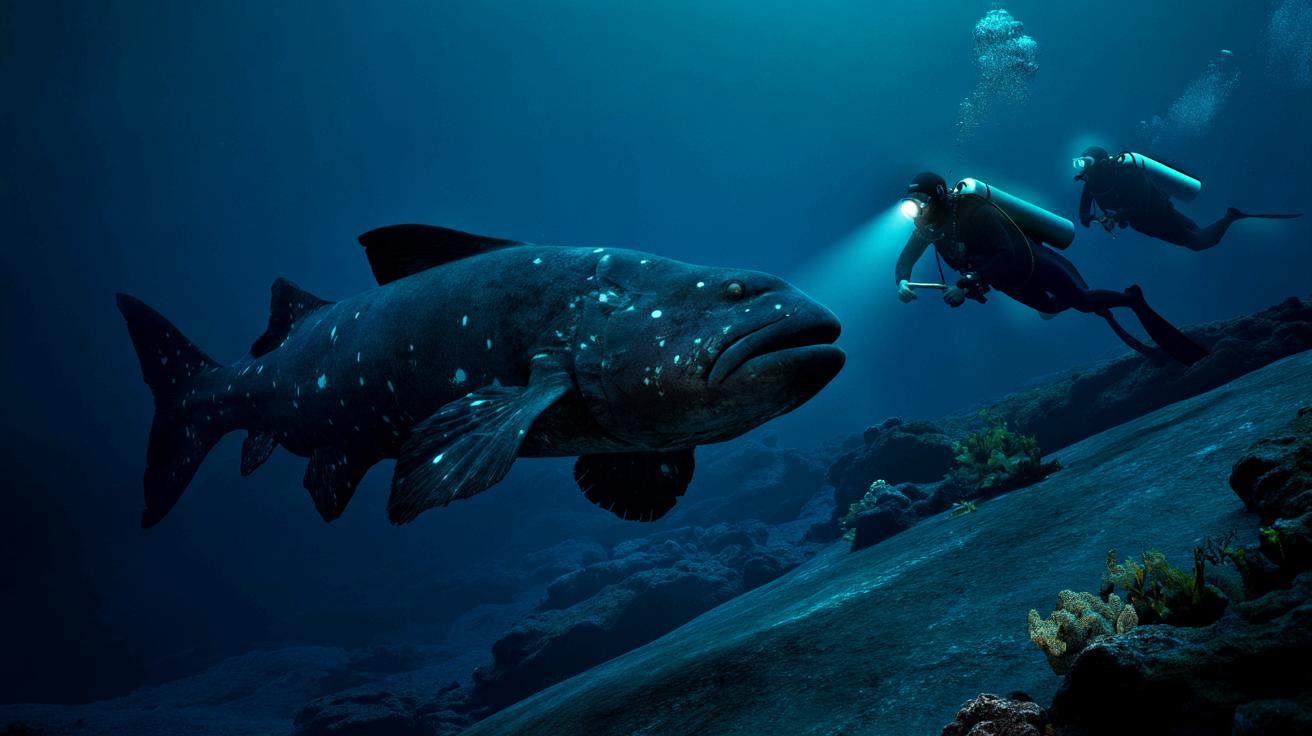
The encounter took place in the remote Maluku archipelago of Indonesia, during a meticulously planned scientific mission that pushed technical diving to its edge and brought back rare images of an animal once thought lost to history.
A silent shape in the dark: the first French images in Indonesian waters
In October 2024, French divers Alexis Chappuis and Julien Leblond descended through the warm surface waters off the Maluku Islands, slipping past the recreational limits of scuba and into the cold, dense twilight below 140 metres.
They were not looking for a wreck or colourful reef fish. Their target was a legend of evolutionary biology: the coelacanth, a deep-sea fish whose lineage stretches back hundreds of millions of years.
Equipped with advanced “closed-circuit rebreather” systems, they followed a steep underwater slope pitted with ledges and rocky overhangs. This jagged terrain, mapped months in advance, matched known habitats of coelacanths elsewhere in Indonesia and off East Africa.
Then, in the glow of their lamps, a thick-bodied, dark-blue fish appeared, speckled with irregular white spots. It hovered above a sponge-covered rock, moving with slow, deliberate strokes of its fleshy fins.
For several long minutes, the animal stayed calmly in view, showing none of the frantic escape behaviour often seen in deep-sea species when confronted with divers’ lights.
The next day, on a second technical dive to the same area, the pair encountered the same individual again. They identified it by the unique “constellation” of white marks scattered across its flanks, a natural pattern that acts almost like a fingerprint.
Two years of preparation for a few minutes of footage
This was not a lucky holiday sighting. Chappuis had spent nearly two years poring over bathymetric charts, scientific literature and local testimonies to narrow down possible coelacanth refuges in the Maluku region.
He targeted areas where cold, oxygen-rich currents brush steep slopes between about 100 and 300 metres deep. These conditions match coelacanth hotspots near Sulawesi, South Africa and the Comoros.
➡️ Greenland crisis: Denmark urges officials to switch off Bluetooth to avoid spying risk
➡️ People who feel uncomfortable slowing down often associate stillness with vulnerability
➡️ Gen Z is losing a 5,500‑year‑old skill: 40% are losing mastery of handwritten communication
➡️ How to clean a blackened patio and garden paths with almost no effort
➡️ Scientists discover an object from another system racing toward us at record speed
➡️ Astronomers think they finally know what James Webb’s mysterious “little red dots” really are
More than fifty test dives were carried out before the October mission hit the right spot. The precise coordinates of the site are now kept confidential to reduce the risk of disturbance by extreme tourism or unregulated expeditions.
The encounter, detailed in the journal Scientific Reports, represents the first documented in situ observation of a living coelacanth in Indonesia’s Maluku province.
For deep technical divers, it also stands as a reminder of how fragile such ventures are. At 145 metres, any error can be fatal. Decompression obligations are huge, and gas management leaves no room for improvisation.
A fish that rewrote evolutionary history
The coelacanth has an unusual story. For decades, it survived only in fossils, last seen in rocks dating back around 66 million years. Paleontologists assumed it vanished with the dinosaurs.
That narrative collapsed in 1938, when a trawler off South Africa brought up a strange blue fish. Museum curator Marjorie Courtenay-Latimer recognised it as a coelacanth, blowing a hole in the idea that its lineage was long dead.
Since then, researchers have identified two modern species:
- Latimeria chalumnae, found in the western Indian Ocean, especially near the Comoros and South Africa.
- Latimeria menadoensis, the Indonesian species, first confirmed in the late 1990s near Sulawesi and now filmed again in Maluku.
The Indonesian specimen recorded by the French team measured roughly 1.10 metres in length. Contrary to earlier assumptions that coelacanths hide deep inside caves during the day, this individual was out in the open, patrolling slowly around a rocky promontory.
Its relaxed posture, fins spread and body almost suspended in place, hints at more flexible behaviour than the “strictly sedentary” stereotype given to the species.
Why scientists care so much about a slow-moving fish
Coelacanths belong to an ancient group called lobe-finned fishes. Their paired fins are chunky and articulated, supported by bone structures that vaguely resemble limbs.
Inside, they carry the remnants of a lung, and their skull is split into two movable sections joined by a special joint. These features make the fish an invaluable model for understanding the transition from life in water to life on land.
Researchers use coelacanths to investigate how early vertebrates may have developed weight-bearing limbs, new breathing systems and more complex skull mechanics.
| Feature | Why it matters |
|---|---|
| Lobe-shaped fins | Offer clues about how fins could evolve into limbs capable of supporting weight on land. |
| Vestigial lung | Hints at ancient air-breathing abilities in fish that predate modern lungfish and amphibians. |
| Two-part skull | Shows a rare jaw and head mechanism, shedding light on feeding strategies in early vertebrates. |
Genetic studies show that coelacanths are not frozen in time. Their DNA has changed, just slowly, over millions of years. The label “living fossil”, while catchy, underplays this gradual evolution.
A fragile life in the deep: threats to a hidden species
Coelacanths usually live between 100 and 400 metres down. These zones are cold, dark and hard to access, which has given the fish a kind of natural shield against frequent human contact.
That shield is thinning. Deep-sea fishing, plastic pollution, warming waters and the constant expansion of maritime traffic all creep into these depths. Noise from ships and sonar can disrupt animal behaviour, while microplastics fall onto the seabed.
The International Union for Conservation of Nature (IUCN) lists the Indonesian coelacanth as “vulnerable”. Several life-history traits explain this status:
- They reach sexual maturity only around the age of 50–55 years.
- Gestation is extremely long, around five years for each brood.
- Individual lifespans can exceed a century.
This slow rhythm means that the loss of even a few adults can have disproportionate effects on the survival of a local population.
The Maluku sighting does not yet prove that a stable population lives in the area, but it strongly suggests that suitable habitat exists between Sulawesi and West Papua. Many submarine valleys and slopes in this corridor remain unmapped in detail.
Protecting deep habitats without touching the animals
For conservationists, the priority now is not to catch coelacanths, but to understand where they live and how they move. The research team behind the Maluku dive wants to rely on non-invasive techniques.
One promising approach is environmental DNA (eDNA). Seawater samples can hold traces of skin cells, mucus or waste from coelacanths. Analysing this genetic material may reveal their presence over large areas without a single net being cast.
Coupled with sonar mapping and remote cameras, eDNA could help define protection zones in deep-water corridors used by the fish. Such methods also limit direct disturbance at depth, where every artificial light or diver can alter normal behaviour.
Technical diving: science at the edge of human limits
The Maluku mission highlights how modern diving technology is reshaping marine research. Rebreathers recycle exhaled gas, scrub out carbon dioxide and add oxygen, allowing longer, quieter dives with far fewer bubbles than conventional tanks.
This silence makes close observation of sensitive species more likely. Yet the risk profile is high: equipment failures are harder to manage, and decompression schedules become complex as depth increases.
Teams planning similar dives usually train for years, running simulations of gas loss, decompression sickness scenarios and emergency ascents. Support boats often stand by with oxygen, medical kits and communication links to specialist doctors on shore.
Coelacanths, myths and the public imagination
The rediscovery of the coelacanth in the 20th century triggered a wave of headlines about “living fossils” and prehistoric monsters. That narrative still shapes how the public imagines the deep sea: as a space where time almost stops.
In reality, deep ecosystems change, just at a different pace from the busy coastal shallows. Coelacanths are part of that slow-turning clock. They remind scientists that lineages can persist through several mass extinctions, adapting just enough to survive.
For non-divers, the story also opens a door to practical questions: what other species are waiting in similar hidden pockets, and how might everyday choices on land reach them? Waste management, carbon emissions and pressure on fisheries all ripple down the water column.
As researchers test new ways to track coelacanths without catching them, the same tools can help monitor sharks, deep snappers and other commercial or at-risk species. Combined, these efforts build a more complete picture of how human activities stack up in the ocean, from beaches to abyssal plains.