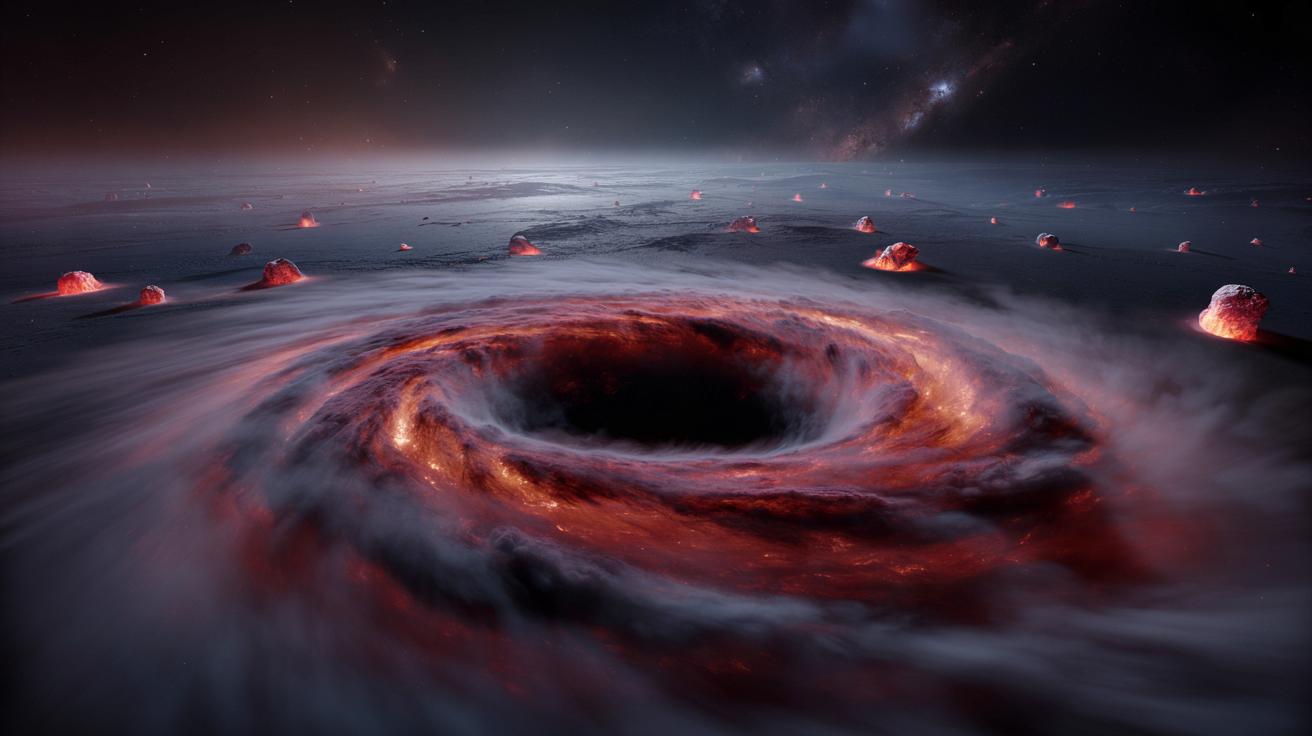
The “little red dots” looked like impossibly compact galaxies from the young Universe, or something even stranger. Now, new observations and fresh modelling from European and South American teams point to a different culprit: a swarm of buried supermassive black holes, wrapped in thick cocoons of gas.
The puzzle of James Webb’s little red dots
When the James Webb Space Telescope (JWST) began full science operations in mid‑2022, astronomers expected surprises. They did not expect hundreds of tiny, intensely red blobs popping up in some of the earliest images of the cosmos.
These sources, quickly nicknamed “Little Red Dots” (LRDs), appeared just 500 to 700 million years after the Big Bang. In cosmic terms, that is almost the newborn phase of the Universe.
At first glance, they looked like extremely compact, star‑stuffed galaxies. That possibility was already strange. Building so many stars, in such tight spaces, so early, made standard models of galaxy growth look painfully slow.
The little red dots forced astronomers to ask whether they had misunderstood how fast structure formed in the infant Universe.
Another idea quickly followed: perhaps many of the dots were not extreme galaxies, but extreme black holes. Supermassive black holes, millions of times heavier than the Sun, sitting at the centres of budding galaxies.
Early hints of hidden giants
Evidence for that black‑hole scenario strengthened through 2024 and 2025. One object in particular drew attention: a source labelled CANUCS‑LRD‑z8.6, analysed in detail with JWST’s infrared instruments and described in a 2025 paper in the journal Nature Communications.
In its spectrum, researchers found gas whipping around at thousands of kilometres per second. That level of motion strongly hints at a massive compact object – almost certainly a black hole.
Brazilian astrophysicist Rodrigo Nemmen, writing in a companion commentary in Nature, went further and called the evidence for a supermassive black hole in at least this dot “irrefutable”.
➡️ Scientists discover an object from another system racing toward us at record speed
➡️ People who feel uncomfortable slowing down often associate stillness with vulnerability
➡️ Greenland crisis: Denmark urges officials to switch off Bluetooth to avoid spying risk
➡️ Waze and Google Maps no longer show the shortest routes, angry users speak out
➡️ How to clean a blackened patio and garden paths with almost no effort
Yet big problems remained. Standard supermassive black holes, especially when actively feeding, tend to blaze in X‑rays and radio waves. These early objects did not. And earlier mass estimates suggested they were wildly overweight for their age.
Black holes hiding in gas cocoons
A new study led by a team at the University of Copenhagen now offers a more coherent picture. The group analysed the spectra of several LRDs using JWST’s infrared spectrographs, which split the incoming light into its component wavelengths.
The patterns they found match what you would expect from actively feeding supermassive black holes that are wrapped in dense clouds of gas and dust.
In this scenario, the “little red dots” are not baby galaxies alone, but young black holes swaddled in thick, glowing cocoons.
The cocoon absorbs most of the high‑energy radiation. X‑rays and radio waves that would normally escape from hot matter near the black hole’s edge are soaked up by the surrounding gas. That explains why telescopes looking for those signals saw almost nothing.
Yet as the black hole devours part of this shroud, it heats the gas to extreme temperatures. The gas then shines strongly in infrared light. Because the Universe is expanding, that infrared glow is stretched into even redder wavelengths by the time it reaches us, making the objects stand out as bright red pinpoints in JWST data.
Why the red colour matters
The unusual colour of LRDs is not just a visual curiosity. It carries physical meaning:
- Dust and gas absorption: Blue and ultraviolet light are swallowed by the cocoon, leaving redder light to escape.
- Cosmic redshift: The expansion of the Universe stretches the light’s wavelength, shifting it towards the red and infrared.
- Hot dust glow: Heated dust grains re‑emit energy mainly at infrared wavelengths, which JWST is designed to pick up.
Together, these effects create the striking “little red dot” signature that puzzled teams from the very first JWST images.
Rewriting the masses – and easing the tension
Armed with this new cocoon‑black‑hole model, the Copenhagen team recalculated the masses of the central objects in several LRDs. Earlier estimates had treated them more like star‑dominated galaxies, which inflated the inferred masses.
Under the new interpretation, the typical black hole mass shrinks by roughly a factor of 100 compared with those initial values. That still leaves plenty of heft: up to around ten million times the mass of the Sun.
These are no longer unthinkably huge anomalies, but hefty young black holes that fit more comfortably within standard models of cosmic evolution.
This shift eases a growing tension in cosmology. If the earlier, vastly higher masses had been correct, theorists would have been forced to overhaul how fast black holes can grow, or posit exotic formation routes in the very early Universe.
Now, the growth rates look demanding but manageable. Black holes could reach millions of solar masses in a few hundred million years by swallowing gas efficiently during these brief, cocooned phases.
A Universe full of chrysalis black holes?
Hundreds of LRDs have already been catalogued in JWST deep fields. If most of them are indeed cocooned supermassive black holes, early cosmic history may have been far more active than expected.
That raises new questions:
- How long does each cocoon phase last?
- How often does a growing black hole go through such buried episodes?
- What happens to the host galaxy while the central black hole feeds?
Researchers liken the process to a metamorphosis. While enshrouded, the black hole remains partly hidden, its energy trapped in the surrounding gas. As it consumes and blows away that gas, it may transition into a more traditional bright quasar, visible across billions of light‑years.
If that picture holds, the early Universe might have been packed with “chrysalides” – black holes in transition, about to break out as full‑fledged quasars.
What astronomers will look for next
The case for cocooned black holes is strong for a subset of the little red dots. Researchers still want to test whether the same explanation fits the entire population.
Several strategies are on the table:
- Deeper JWST spectroscopy: Measuring more detailed spectral lines to track gas speeds and densities around the central objects.
- Stacked X‑ray data: Combining observations to see if faint average X‑ray emission appears, consistent with heavily obscured black holes.
- Radio follow‑up: Searching for weak radio jets that might leak through the cocoon in some cases.
- Numerical simulations: Running high‑resolution models of early galaxies hosting fast‑growing black holes inside gas‑rich environments.
Each approach probes a different piece of the puzzle, from the feeding habits of the black holes to the structure of the gas around them.
Key terms behind the headlines
For anyone trying to make sense of this debate, a few concepts help:
| Term | What it means |
|---|---|
| Redshift (z) | A measure of how much the Universe has expanded since the light was emitted; higher z means earlier times. |
| Spectrum | The breakdown of light by wavelength, showing bright or dark lines tied to specific atoms and physical conditions. |
| Supermassive black hole | A black hole with a mass from millions to billions of Suns, usually found at the centres of galaxies. |
| Accretion | The process of gas and dust spiralling into a black hole, releasing energy as it falls. |
| Obscuration | Blocking of light by intervening gas and dust, which can hide energetic sources at some wavelengths. |
Why cocoons matter for galaxy growth
These early black‑hole cocoons are more than a curiosity. As they feed, they pump energy and sometimes powerful winds into their surroundings. That feedback can reshape their host galaxies.
Fast‑growing central black holes might help shut down star formation by heating or expelling gas. Or, in some cases, they might compress nearby gas clouds and trigger new bursts of star birth. Which effect wins could depend on the thickness of the cocoon and how the energy escapes.
By mapping many LRDs at different ages and stages, astronomers hope to trace this two‑way relationship. That connection between black holes and galaxies remains one of the core questions in modern astrophysics.
A glimpse of the first cosmic engines
For now, the little red dots stand as signposts to the first generation of massive black holes powerful enough to shape their neighbourhoods. They show that, even a few hundred million years after the Big Bang, the Universe already hosted compact engines capable of swallowing vast amounts of matter.
As JWST keeps pushing deeper, and as future observatories join the effort, more of these buried engines will likely surface from the data. Each one adds a piece to the story of how darkness, gas and gravity combined to light up the early cosmos.