The alert didn’t arrive with a Hollywood soundtrack.
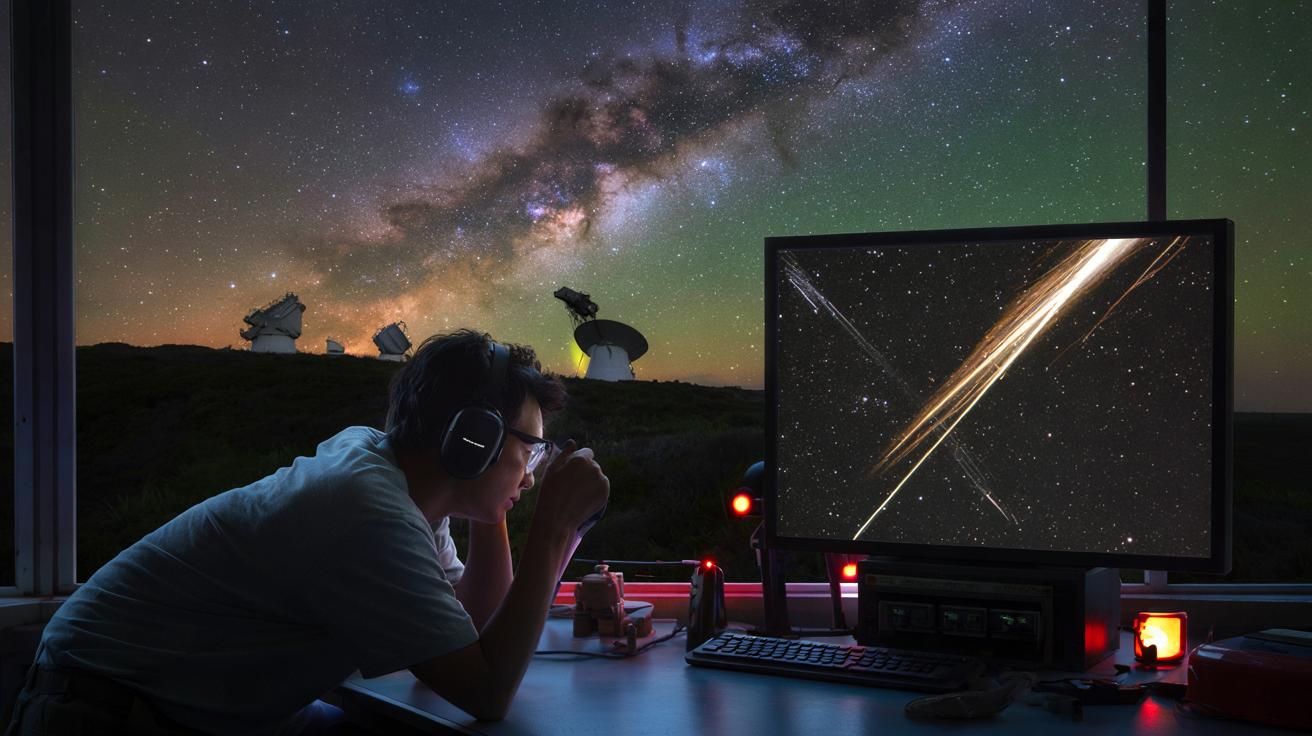
It appeared as a thin red line on a monitor at a hillside observatory in Hawaii, in the kind of quiet, humming room where coffee is always slightly burnt and the air smells of electronics. A young astronomer squinted at the screen, frowned, and zoomed in. Something was moving across the stars. Fast. Way too fast.
Within hours, a flurry of emails, Slack pings, and late-night calls crossed the globe. From Chile to Spain to Australia, telescopes swiveled like curious heads in the dark. An object from deep space, not bound to our Sun, seemed to be sprinting straight through our cosmic neighborhood at a speed that made even seasoned researchers catch their breath.
The numbers did not look like anything from here.
A mysterious visitor slingshots into our sky
On the screen, the object didn’t look like much. Just a tiny streak, a shifting pixel against a velvet background. Astronomers are used to that kind of underwhelming first impression. Comets, asteroids, rogue rocks — they arrive as dots, not drama.
What shook them wasn’t the look of this visitor, but its path. Its orbit was all wrong for anything born in our Solar System. The curve cut through the planetary lanes at a wild angle, like a car flying in from an exit that doesn’t exist on the map. The math kept repeating the same story: this thing was coming from somewhere far beyond our Sun’s gravitational family.
The first measurements suggested a speed that made even the infamous interstellar object ‘Oumuamua look slow. Early estimates: more than 100,000 kilometers per hour relative to the Sun, and climbing as it dropped into our gravity well. That’s roughly fast enough to cross the distance from Earth to the Moon in just a few hours.
Observatories checked for errors. Wrong calibration, faulty timing, a misidentified satellite — the usual suspects. But the data held. Night after night, the streak returned on schedule, cutting its precise, improbable track through our sky. The object had no interest in slowing down. It was just passing through, on a record-breaking sprint.
Once the “from another star system” label went up on internal chats, things accelerated almost as fast as the object itself. Teams that usually compete started sharing code and images. Spectrographs were reserved at stupid o’clock hours. Proposals were rushed to space agencies: Could existing spacecraft be re-aimed? Was there time for a fast-response mission?
Scientists know they’re catching just a glimpse of this traveler. Its path tells them it’s not captured, not staying, just slicing through our neighborhood before racing back to the cold gulf between stars. That rarity is exactly what makes it so electrifying. This is cosmic drive-by science: one chance, short window, no reruns.
How you study something that won’t stay still
Trying to study an object like this is a bit like trying to interview someone who sprints past your front door and never comes back. You get fragments. A shout. A blur of color. Maybe a detail like the pattern on their shoes if you’re very quick.
➡️ Gen Z is losing a 5,500‑year‑old skill: 40% are losing mastery of handwritten communication
➡️ Waze and Google Maps no longer show the shortest routes, angry users speak out
➡️ People who feel uncomfortable slowing down often associate stillness with vulnerability
➡️ Greenland crisis: Denmark urges officials to switch off Bluetooth to avoid spying risk
➡️ How to clean a blackened patio and garden paths with almost no effort
Astronomers start with the basics. They track its precise position against the background stars every few minutes, sometimes every few seconds. From that, they refine the orbit — the exact curve through space. Then they aim larger telescopes to catch the faint light bouncing off its surface. The color and intensity of that light can whisper clues about what it’s made of: metal-rich rock, dusty ice, something darker, stranger.
The race becomes almost physical. Observatories hand off the object like a baton as the Earth rotates. Hawaii sees it first, then Chile, then the Canary Islands. When clouds roll in, hearts sink. When the atmosphere wobbles and blurs the view, precious data is smeared into uselessness.
We’ve all been there, that moment when something rare finally arrives and real life throws a wrench into your plans. For these teams, that wrench is often weather. There’s a quiet, shared anxiety in the control rooms: if they miss this window, they don’t get another. No second season, no rerun, no “we’ll catch it next year.”
Behind the scenes, supercomputers get to work. They rewind the object’s path through space, trying to guess which region of the galaxy it came from. Was it flung out of a young, chaotic star system where giant planets behave like pinballs? Did it escape a fading red dwarf, ejected after a close gravitational encounter?
Some models suggest these interstellar visitors might be common — constantly zipping through the galaxy — but almost always too faint for us to notice. That’s the plain truth: most of what moves through the universe passes us by unseen. When one of these travelers is bright and fast enough to catch our eye, it feels less like routine astronomy and more like a rare knock on the door from the wider cosmos.
What this runaway rock can quietly change for us
No one is pretending this object is a threat. Its path doesn’t cross Earth’s orbit in a worrying way, and it’s not some secret alien ship dropping out of warp. The impact it brings is less cinematic and more subtle: a chance to upgrade our entire way of watching the sky.
Every time something unexpected appears, tracking systems get stress-tested. Software is rewritten, alert networks improved, telescopes taught to pivot just a bit faster. Think of it as an unplanned fire drill for planetary defense. If we can successfully follow an object from another star system racing past us at record speed, we’re that much closer to catching the next dangerous rock early enough to react.
There’s also a quieter human lesson tucked inside this story. Some people hear “interstellar object” and instantly imagine doom, secret cover-ups, or a cosmic warning. Fear fills in the gaps where knowledge is still thin.
Scientists feel that gap too. They just respond differently. They throw more telescopes at it, more spreadsheets, more late-night video calls. They speak openly about what they don’t yet know, instead of pretending they have all the answers. Let’s be honest: nobody really reads every dry research paper or sits through a full livestreamed conference talk. What sticks are the moments when a researcher looks tired, excited, and says, “We didn’t expect this, and it’s kind of blowing our minds.”
The emotional jolt in the community is very real. This new object joins a tiny club of known interstellar visitors, and it’s moving even faster than the ones before. That means it carries a different kind of memory from its birth system — a different history of collisions, near-misses, and violent beginnings.
“Each of these objects is a message in a bottle from another shore of the galaxy,” one researcher told me quietly. “We probably won’t ever see their home, but we can hold this little fragment of its story up to the light.”
- Origin clues: Its speed and trajectory hint at the gravitational chaos that kicked it out of its native system.
- Material secrets: Its reflected light can reveal whether other systems build worlds from the same stuff as ours.
- Detection upgrade: The scramble to observe it helps refine the global early-warning network for all near‑Earth objects.
- Cultural impact: Stories like this subtly shift how we see ourselves — less as center stage, more as one orbit among many.
- Future missions: Each visitor feeds the argument for rapid-response spacecraft ready to chase the next one.
A fast visitor, a slow shift in how we see our place
What lingers after the buzz of discovery is not just the data, but the quiet rearrangement of perspective. Earth feels a little less isolated when an object from another system cuts through our sky, leaving a temporary scar in our models and a permanent mark in our imagination.
Kids who look up tonight may never see this object with their own eyes, yet they’ll grow up in a world where “interstellar visitor” is no longer pure science fiction. It’s a line on a real-time dashboard, a notification on a scientist’s phone, a quick sketch in someone’s research notebook. *The universe has started to feel less like a distant backdrop and more like an active conversation we’ve only just learned to overhear.*
For some, that’s unsettling. If rocks can be thrown across light-years, what else is out there, moving in the dark? For others, it’s a strangely calming expansion of context. Our local dramas don’t shrink, exactly, but they start to share space with a universe that is messy, busy, and utterly indifferent to our deadlines and anxieties.
The new object will soon fade from view, slipping back into the anonymous black between stars. Data will harden into numbers, numbers into graphs, graphs into papers, and the news cycle will move on. Yet a subtle shift remains: another tiny thread connecting our small blue world to the wider galaxy, another reminder that our Solar System is not a sealed room, but a hallway with doors we’re only just noticing.
| Key point | Detail | Value for the reader |
|---|---|---|
| Record‑speed visitor | Interstellar object passing through the Solar System at unprecedented velocity | Offers a rare, real‑time glimpse of something born around another star |
| Scientific scramble | Global telescopes and teams coordinating to track and analyze a fleeting target | Shows how quickly humanity can respond when the sky throws us a surprise |
| New perspective | Discovery challenges our sense of isolation and upgrades detection systems | Connects personal curiosity with concrete gains in planetary safety and knowledge |
FAQ:
- Question 1Is this object dangerous for Earth?Current orbital calculations say no. Its trajectory takes it through the Solar System at high speed without a collision course with our planet.
- Question 2Could this be an alien spacecraft?There’s no evidence for that. The data so far fits a natural object, like a rock or icy body ejected from another planetary system.
- Question 3How do scientists know it’s from another star system?Its speed and path don’t match anything gravitationally bound to the Sun. The orbit is “hyperbolic,” meaning it’s just passing through and will never return.
- Question 4Can we send a spacecraft to chase it?With current technology and the short notice, catching up would be extremely hard. The discovery still fuels plans for future rapid‑response missions.
- Question 5Why should ordinary people care about this discovery?It helps improve asteroid detection, deepens our understanding of how other systems form, and quietly reshapes how we see our place in the galaxy.