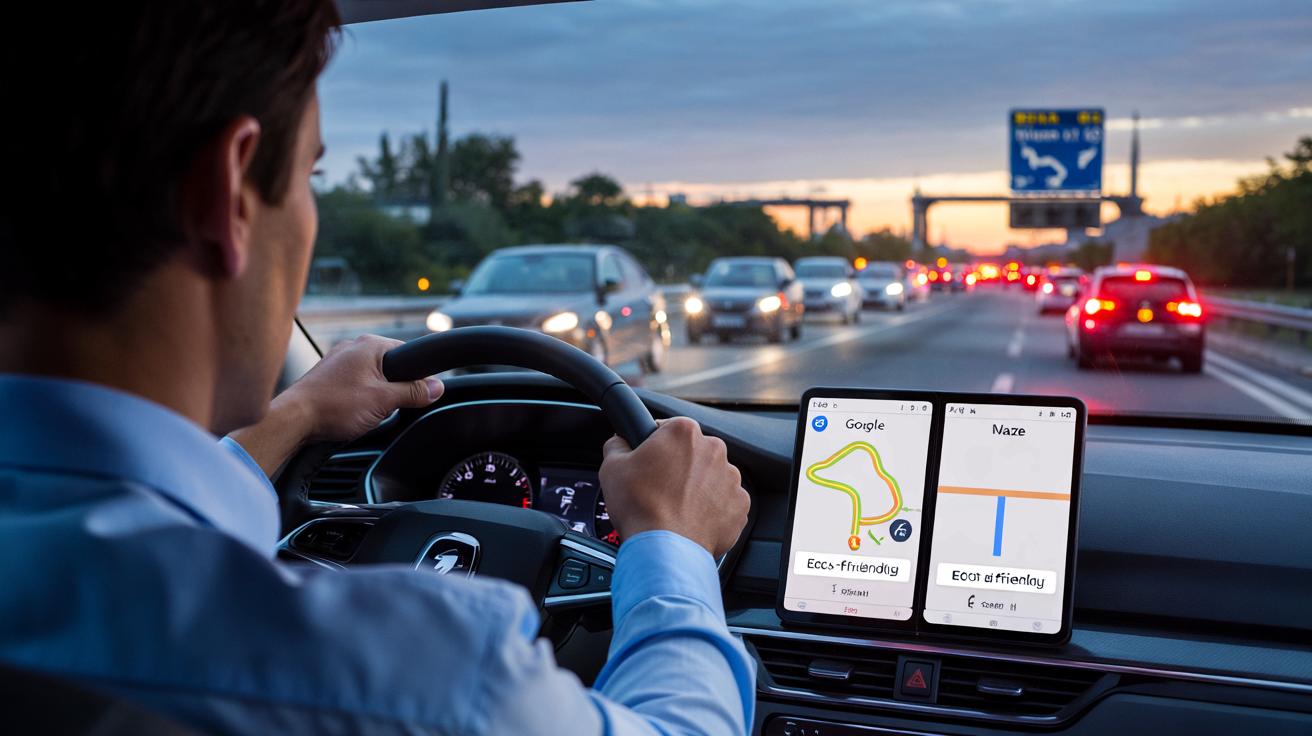
The change is not a glitch, nor a bug: Waze and Google Maps are quietly reshaping how millions of people move, pushing them away from the fastest roads and towards routes designed to cut emissions and ease congestion.
Why your shortest route suddenly disappeared
Users across France have started noticing that their usual quickest route is no longer the first option on Waze or Google Maps. Instead, the apps highlight an itinerary that often takes a few minutes longer but promises a lower environmental impact.
This is the direct result of a French regulation: decree no. 2022-1199. It targets “digital services that assist with travel” and forces them to prioritise the routes that emit the least greenhouse gases.
France now obliges navigation apps to promote routes with the lowest climate impact, not the shortest distance or fastest time.
Concretely, that means your app may:
- Suggest a slower motorway instead of a high-speed one
- Push you onto national roads rather than ring roads
- Highlight itineraries that avoid stop‑and‑go congestion
- Display the estimated carbon footprint for each option
For many drivers, this shift arrives without a clear on-screen explanation, which helps explain the frustration flooding social networks and comment sections.
What the law actually demands from Waze and Google Maps
The decree sets a clear priority: when several routes are possible, navigation services must “highlight the itineraries with the lowest impact in terms of greenhouse gas emissions”. Speed and distance come second.
There is also a specific rule aimed at fast roads. If the main route includes a section where the speed limit is at least 110 km/h, the app must show an alternative reducing that maximum speed by 20 km/h. So a stretch of 130 km/h motorway must be paired with a 110 km/h option.
Apps must now visibly display the carbon footprint of each trip, so users make a conscious choice about emissions.
➡️ Greenland crisis: Denmark urges officials to switch off Bluetooth to avoid spying risk
➡️ Scientists discover an object from another system racing toward us at record speed
➡️ People who feel uncomfortable slowing down often associate stillness with vulnerability
➡️ Gen Z is losing a 5,500‑year‑old skill: 40% are losing mastery of handwritten communication
➡️ How to clean a blackened patio and garden paths with almost no effort
In practice, the interface changes in two key ways:
| Before the decree | After the decree |
|---|---|
| Default option: shortest or fastest route | Default option: route with lowest emissions |
| CO₂ impact rarely displayed, or hidden in settings | CO₂ estimate shown prominently next to each route |
| High-speed motorways often prioritised | Alternative slower routes must be clearly proposed |
Drivers can still select the old, faster route in most cases, but they must now actively tap away from the eco‑option the app puts forward first.
From green policy to everyday annoyance
For the French government, the move fits into a broader climate strategy. Road transport is a major source of emissions, and navigation apps subtly steer the behaviour of millions of people every day. Tweaking those algorithms is an attractive lever.
For users rushing to childcare, work, or a medical appointment, losing two, five or ten minutes can feel like a direct attack on their routine. Many complain they never consented to this “eco-driving experiment”.
The tension lies here: what feels like a small collective gain in emissions can look like a personal loss of time and control.
Paris 2024, congestion fears and political pressure
The environmental angle is only part of the story. Officials in the Paris region have been worried for months about massive congestion, especially during large events such as the Olympic Games.
The regional transport authority, Île-de-France Mobilités, openly pressured Google to change how Maps behaves during these peak periods. Their concern: if every navigation app continues to funnel drivers to the fastest routes, a handful of key arteries could gridlock completely.
To avoid that, the authority pushed for routing that spreads drivers across alternative, sometimes slightly longer, itineraries. Its own app, “Île-de-France Mobilités”, already works that way, deliberately avoiding the systematically shortest options.
The regional transport chief even warned that, if tech firms refused to cooperate, the state could be asked to shut down their apps on security grounds.
This shows how navigation tools have become a matter of public safety, not just convenience. When an algorithm can jam or unblock a whole area, politicians start treating it like infrastructure.
How routes are becoming ‘eco‑friendly’
Behind the scenes, suggesting a greener route is more complex than simply lowering speed limits. Apps blend several factors to estimate emissions:
- Average speed and driving style along each road segment
- Historical congestion data and typical stop‑and‑go patterns
- Road type: motorway, national road, urban street
- Elevation changes and known bottlenecks
At higher speeds, air resistance increases sharply, and cars burn more fuel. That is why a slightly slower motorway, or a national road with steadier traffic, can sometimes produce notably lower emissions than a technically “faster” option.
Apps try to combine these parameters into a simple estimate, displayed next to each route, usually in grams or kilograms of CO₂. The numbers are averages, not personalised data, but they give an order of magnitude.
Why a longer trip can still be ‘better’
For drivers judging only by time or distance, the logic feels twisted. Yet from an energy perspective, a smoother 25‑kilometre route at 90 km/h can be cleaner than a 22‑kilometre sprint at 130 km/h filled with braking and lane changes.
Less acceleration, fewer sudden stops, and lower top speeds all cut fuel consumption. When this behaviour is scaled up across thousands of drivers in a region, the emissions savings add up quickly.
What this means for everyday drivers
On a daily basis, French users can expect several practical changes when using Waze or Google Maps:
- The default suggested route might be slightly longer in time or distance
- The fastest route will usually remain available, but no longer highlighted
- CO₂ indicators will appear more often and in more prominent places
- During big events or traffic alerts, apps may push you strongly towards alternative roads
For people with strict schedules or limited fuel budgets, this raises questions. Does a greener route cost more petrol because of extra distance, or less because of smoother driving? The answer varies trip by trip. In some cases, the eco‑route also saves fuel costs; in others, it mainly benefits emissions and congestion.
Balancing user freedom and collective goals
This shift in France could act as a test case for other countries. Regulators in Europe and beyond are watching how users react when climate objectives begin to subtly influence their sat‑nav instructions.
If complaints stay limited, lawmakers might feel emboldened to tighten rules, for example by making eco‑routes the only default in certain zones or at specific times of day. If backlash grows, they may demand clearer toggles and better transparency in the apps instead.
Scenarios: how it could play out on your screen
Imagine a Monday morning commute from a suburb to central Paris:
- Before the decree, your app pushed the peri-urban motorway, promising “35 minutes, fastest route”.
- Now, it first suggests a mix of ring road and national road: “40 minutes, lower emissions”.
- The old motorway route still appears, but as a secondary choice with a warning about higher CO₂ and possible congestion.
Or picture a holiday drive across France in August. The app may propose a slower motorway with a 110 km/h limit instead of a popular 130 km/h corridor known for traffic jams. On paper you lose ten minutes; in reality, you might avoid spending half an hour stuck in a tailback under the sun.
Key terms and ideas behind the change
Several concepts underpin these new routing rules, and understanding them can make the changes feel less arbitrary:
- Carbon footprint of a trip: the estimated quantity of CO₂ and other greenhouse gases released from fuel burnt during that specific journey.
- Eco‑routing: routing that optimises for fuel efficiency and emissions, not purely for speed or distance.
- Traffic smoothing: strategies that spread vehicles across multiple roads to avoid total saturation of a few main axes.
Drivers might not agree with policymakers on the right balance between personal time and collective emissions, but navigation apps are now officially part of that negotiation. The shortcut you no longer see as a first choice is a sign that this debate has moved from parliamentary chambers to the small blue line on your phone screen.