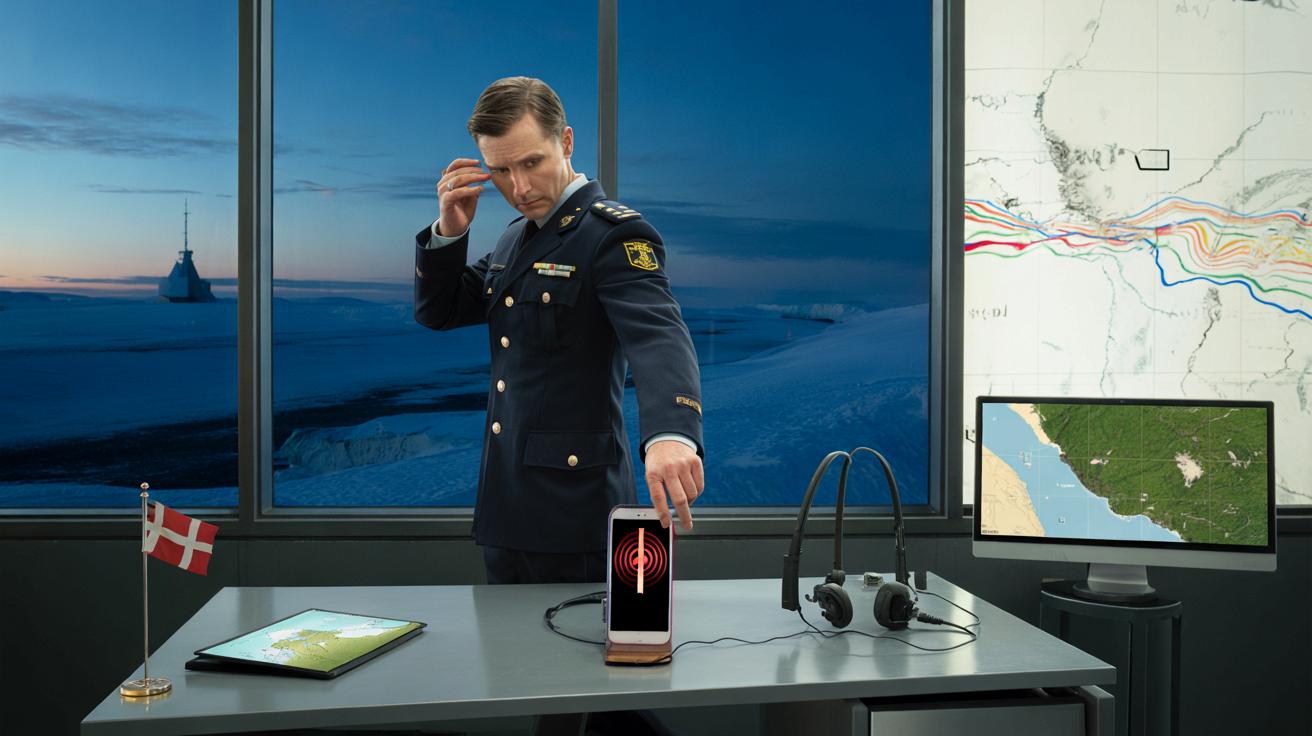
The Danish state, usually known for calm pragmatism, is suddenly nervous about invisible threats in the airwaves, far from any visible battlefield.
Bluetooth under suspicion as geopolitical tensions flare
Denmark is not officially at war, yet its security posture is shifting. The immediate trigger is a sharp rise in geopolitical friction over Greenland, where US ambitions and European interests collide in a strategically vital part of the Arctic.
Against this backdrop, Danish military intelligence and cybersecurity advisers have flagged an unexpected weak point: Bluetooth headsets and wireless earbuds used inside core government services.
Police officers, civil servants and staff in key state institutions have been told to switch off Bluetooth on phones, tablets, laptops and accessories while on duty.
The warning, first revealed by the Danish tech outlet Ingeniøren, covers both state-issued and privately owned devices used for work. The focus is on “regalian” administrations: ministries, law enforcement, and other bodies handling classified or politically sensitive information.
From everyday gadget to intelligence risk
Bluetooth has long been known in cybersecurity circles as a soft entry point. It was designed for convenience, not for hardened, military-grade secrecy.
Security researchers have repeatedly demonstrated how bugs in Bluetooth protocols can allow an attacker to:
- Take control of a device remotely
- Intercept audio or data streams
- Plant malware or force connections without the user’s consent
Among the protocols named in the Danish debate is BlueBorne, a known vulnerability affecting a range of devices from laptops to smartphones. More recently, security teams have also flagged attacks exploiting Google’s Fast Pair feature to hijack or spoof Bluetooth accessories.
In some cases, a nearby attacker does not need your permission or pairing approval to eavesdrop or interfere with your devices.
➡️ Scientists discover an object from another system racing toward us at record speed
➡️ Astronomers think they finally know what James Webb’s mysterious “little red dots” really are
➡️ How to clean a blackened patio and garden paths with almost no effort
➡️ Gen Z is losing a 5,500‑year‑old skill: 40% are losing mastery of handwritten communication
➡️ Waze and Google Maps no longer show the shortest routes, angry users speak out
That last part is what alarms intelligence services. Traditional “pairing” gives users a false sense of security. If a hostile operator can silently intercept or inject audio, then a casual call with wireless earbuds in a corridor near a meeting room suddenly looks a lot less harmless.
Greenland in the crosshairs
The timing of the Danish warning is not accidental. Greenland, an autonomous territory within the Kingdom of Denmark, has become a focal point for US, European and Chinese strategic interests.
In recent years, Washington has stepped up its Arctic presence and signalled strong interest in Greenland’s location and resources. Controversial remarks from then‑US president Donald Trump, including the idea of “buying” Greenland, rattled Copenhagen and reignited debates about sovereignty, NATO and transatlantic relations.
In such a climate, intelligence-gathering efforts usually increase. Embassies, military bases and government offices turn into high-value targets for both traditional espionage and cyber operations.
“Very specific” incident behind the new advice
According to Danish police sources quoted locally, the recommendation to cut Bluetooth is not just a theoretical precaution. It reportedly stems from a “very specific” incident or suspicion that raised red flags inside the security apparatus.
Details remain classified. Officials stress that they want to prevent panic while quietly tightening operational security. That balance is tricky: admit there is a vulnerability, but avoid fuelling fear among officers and civil servants already under political pressure.
Authorities insist the move is preventive, yet insiders hint that a concrete security scare pushed the guidance over the line.
How a Bluetooth attack might actually work
To understand why Denmark is acting, it helps to picture a realistic scenario rather than a Hollywood hack.
Imagine a police officer in Copenhagen, tasked with surveillance related to Arctic policy meetings. She wears Bluetooth earbuds connected to her smartphone. Nearby, in a café, an agent working for a foreign power runs custom software on a laptop equipped with a powerful Bluetooth antenna.
Without touching the officer’s phone, the attacker scans for nearby Bluetooth devices, identifies the earbuds and exploits an unpatched vulnerability. Within seconds, he may be able to:
- Listen to audio coming from the phone
- Inject fake audio prompts or calls
- Harvest device information that helps track the officer later
No one in the room notices anything. The officer continues her work, unaware that fragments of operational chatter, background conversations or call content are being siphoned off.
Why governments move faster than ordinary users
For everyday users, Bluetooth risks are real but often limited. Someone might steal data, track a device or cause annoyance. For a government, the stakes are much higher.
| Type of user | Main Bluetooth risk | Potential impact |
|---|---|---|
| General public | Data theft, device tracking | Privacy loss, financial fraud |
| Police and military | Audio interception, device compromise | Leaked operations, endangered officers |
| Government officials | Meeting monitoring, location analysis | Diplomatic damage, negotiation leaks |
This difference in impact explains why Danish authorities are willing to disrupt daily routines. Wired headsets are less convenient, but they sharply reduce the attack surface.
Key terms behind the Danish decision
The debate around Denmark’s move includes several technical concepts that shape security choices:
BlueBorne and protocol flaws
BlueBorne is not a single bug but a family of vulnerabilities discovered in 2017 by researchers. It affects Bluetooth implementations in major operating systems such as Android, Windows and some Linux variants.
In practice, BlueBorne showed how an attacker could take control of a device simply by being within Bluetooth range, without any interaction from the victim. That sort of attack model is exactly what makes wireless accessories suspicious in high-security facilities.
Google Fast Pair and device impersonation
Google’s Fast Pair aims to make Bluetooth pairing quick and seamless on Android devices. Yet security teams have flagged ways this convenience can backfire, enabling attackers to impersonate legitimate accessories or trick users into connecting to malicious devices.
In a police station or ministry building, where dozens of devices compete for connections, such tricks become easier to conceal.
What this signals for other countries
Denmark’s move fits a broader pattern: modern states are starting to treat everyday consumer tech as potential espionage tools. Similar debates have emerged around smart speakers, connected cars and office Internet of Things devices.
Other NATO members may watch the Danish experience closely, especially those with Arctic interests or tense relations with major powers. Quietly, many security agencies already ban wireless gadgets from secure meeting rooms. A formal, nationwide guidance simply makes that unofficial practice visible.
For businesses handling sensitive data, the Danish case offers a concrete model. Tech teams might decide to:
- Ban Bluetooth in boardrooms and incident-response rooms
- Require physical mute switches and wired headsets for executives
- Audit which devices are actively broadcasting Bluetooth signals on-site
As Greenland’s strategic value rises, so does the pressure on Denmark’s cyber defences. Bluetooth, a protocol most people barely think about, has become the latest front line in a quiet, digital contest playing out far from the ice sheets that triggered it.